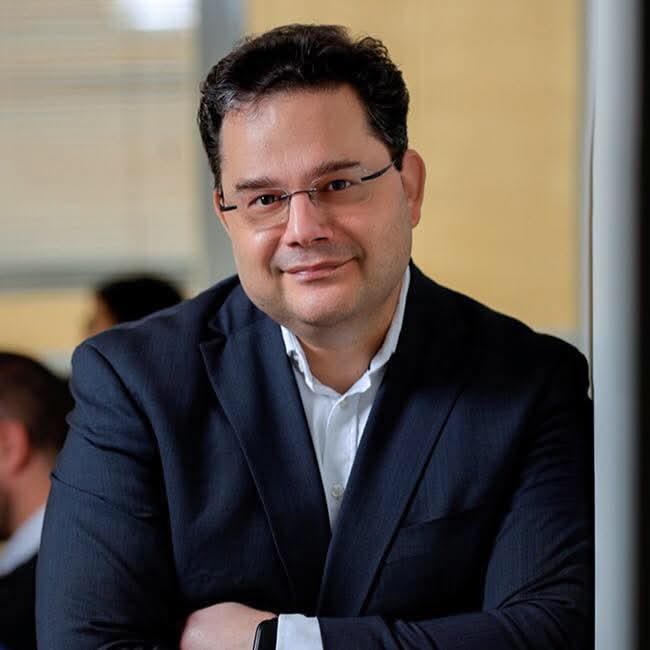
"Kalamata has the potential to become Arles"
With a rare ability to capture the "presence" of the landscape and light, his approach to the world of photography is not limited to simple documentation, but invites us into a deep, honest relationship with nature and time. Through his experience, we have the opportunity to live and feel the world around us in a more sensitive and conscious way.
It is with great joy and enthusiasm that we welcome the acclaimed photographer Larios to our city, Kalamata, for the 1st International Kalamata Photography Meeting. His work, full of respect for nature and humanity, highlights the power of photography as a tool for exploration and expression, creating images that move and provoke thought.
With appreciation and respect, we look forward to Mr. Larios sharing his experiences and artistic perspective, offering participants and visitors of the meeting an invaluable opportunity to immerse themselves in the world of landscape photography, with his unique gaze and passion. His presence in Kalamata will surely be a source of inspiration for all of us.
On the occasion of this interview, we are honored to present some of his thoughts and philosophies, to better understand how his photography shapes his relationship with the world and art.
Interview Natasa Stamatopoulou
Translation Julia Vrioni
1) From the mindset of an engineer and algorithms, to the search for light and silence—when did you realize that photography was not just a hobby, but another way of being?
This transition happened at the same time as the era itself changed—when we moved from analog to digital photography.
I always had a strong interest in photography, I had cameras and experimented, but never with continuity or a specific goal. In 2004, I got my first digital camera and took a photo on our honeymoon in Paris, at the Musée d'Orsay. When we returned, I sent it, almost impulsively, to "Photographer" magazine—and it won an award.
From that moment on, with the possibilities of the new medium, my relationship with photography changed. It was no longer just a hobby. It was no longer a random capture of moments. It was something completely new. Another way to be present. A way to see more clearly. To escape the noise of everyday life, from screens, algorithms, and deadlines. Photography became a different rhythm for me. A way of life. Over time, I learned to see the same world differently. Not with a technical eye, but with an eye that seeks. And where before I saw nothing, thousands of small, beautiful, authentic images began to appear. Secret ones. Images I didn't see before. They were all hidden within the milliseconds of a second, which I was now learning to see.
2) Your work seems to capture not just landscapes, but a return to "presence." What does the word "presence" mean to you within the frame?
For me, presence isn't just a physical placement within a space. It's the complete absence of distraction. It's the moment when there is nothing else—no sound, no thought, no next move. It is that fine, imaginary line between me, the landscape, and the light. It's when photography is not just a "technical" process with the right settings. It's when light is not just a variable to consider in the frame, but a living conversational partner. Presence is the gaze that sits opposite a landscape and waits. It waits—perhaps for hours—for the small miracle that will happen in front of it. It doesn't interfere. It doesn't consume. It doesn't rush. It is there with respect.
In reality, the word "presence" gives meaning to what I do. If you are not present, truly present, then there is no photograph. There is just a random image. Photography begins when you stop seeing the world as something secondary, as a background setting. Photography begins when you start to see the landscape in front of you as a conversational partner. Presence is this change.
And this decision to stand before the landscape and dedicate time, attention, and respect to it—is always conscious. It is not a product of luck. It is a choice. The landscape, nature, is what was there before us, and will be after us. And for me, photography is the way to meet—even for a little while—this eternity.
3) You typically exclude the human form from your images, yet the human experience is ever-present. What is the reason for this choice in your work?
I don't try to remove people from my photos. In reality, I choose not to include them visually within the frame. The human is there, but in a different way. They are the viewer. It is the feeling carried by the one who looks at the photograph. Their non-appearance in the frame, in reality, is not an absence. It is space. Space for the landscape to be heard.
The physical presence of a person in a photograph often functions as the "center." It comes to dominate the scene. I—on the contrary—try to remind people that we are not the center. That there is a beauty that existed before and will continue to exist without us. I am a proponent of the view that nothing can compare to the rejuvenating relationship with nature and the landscape. A simple walk—for example—deep in the heart of a forest, without contact with the distractions of daily life, is healing. Just like waiting for the first light of a new day, in absolute silence. And nothing is more hopeful than photographing the power of "eternal" nature, without people, without the need for us to always be the subject, with the familiar self-referentiality that distinguishes us as a species!
That's why in my photos, the forests, landscapes, and seas are in the foreground—unobstructed and "naked." As they are revealed to you when the crowds withdraw. When people fall silent. Then you hear the light, you see the silence, you feel the space. And within this space, the viewer—each viewer—can project something of their own. An emotion. A loss. A hope. There, the personal becomes universal. And this absence—if you see it differently—is not an emptiness. It is an invitation.
4) Having spent years in structured, technocratic environments, how has this experience influenced the composition and approach of your images?
My experience in technology and business did not keep me away from art. On the contrary, it helped me see it with a clearer eye. I have worked for many years in complex, demanding environments, where thinking had to be fast, strategic, synthetic, and at the same time, efficient. These conditions made me seek, almost instinctively, something complementary on the opposite end: moments of silence, simplicity, and a clear gaze. And so, photography did not just become a hobby or an outlet. It became a way to remember what truly matters.
In composition, I have a natural tendency for clarity and balance. I want the image to have an internal structure, to be able to stand on its own without explanations. This tendency did not come from an artistic education, but from my contact with engineering science and mathematics. From the habit of identifying patterns, organizing my thoughts around axes, and composing solutions. This methodical approach has been transferred almost unconsciously to the way I see and frame the landscape. It's not about cold technique—it's about the need to render a form of order, even within the chaos of a storm or a forest that changes from minute to minute.
So, a creative tension is born there. On one hand, the technocratic side that demands precision, structure, and control. On the other, the photographic side that pushes me to let go, to trust the light and the moment. These two aspects are contradictory, but not competitive. They coexist. And somewhere in between the two, my most sincere images are born.
5) In an age of speed and information overload, how do you believe your art can function as a "resistance" or "respite"?
The landscape photography I create is not meant to "shout." Nor is it meant to grab attention with sensationalism. On the contrary, it seeks to offer space. Time. A breath. We live in a world where everything moves too fast, where every moment seems to need to be used, posted, and to yield a result. And within that, art—and especially landscape photography—can function almost therapeutically. Not as an escape, nor as a resistance. But as a pause. As a reminder that we don't need to constantly run to find beauty. Often, it is already there. Hidden within the seconds. You just have to look for it!
When I create my photographic works in landscapes all over the world, I'm not chasing validation. I'm chasing silence. I'm chasing the essence hidden in a fleeting shadow, in a detail, or in how the last light of the day "writes" across a field. And this process—of anticipation, observation, and absolute concentration—is what makes my photographic works something that they ask you to experience, not just to look at.
This is also why I choose to present my work in large sizes, with absolute attention to printing quality. I want each work to have a physical presence in the space. To be something that invites you to stand in front of it. Not to quickly flip through it or mindlessly "scroll" past it on a tiny screen. When a work has a material substance, a large-sized print on fine-art paper for example, then it appeals to all the senses. And only then can it truly convey the emotion it seeks. Only then can it become a deep breath in a world where everything passes fleetingly. I consider this choice in the way I present my photographic works to be a return to the essence.
6) Is there a specific place, landscape, or light that changed you as a photographer? A moment when you felt that photography was less about documentation and more about revelation?
I couldn't single out just one moment. For me, this shift—from simple documentation to revelation—is a continuous process. Every time I stand in front of a new landscape, I feel as if another window to the world is opening. Something new is being revealed. And every time I capture light in a different part of the world, I understand something more—both about nature and about myself.
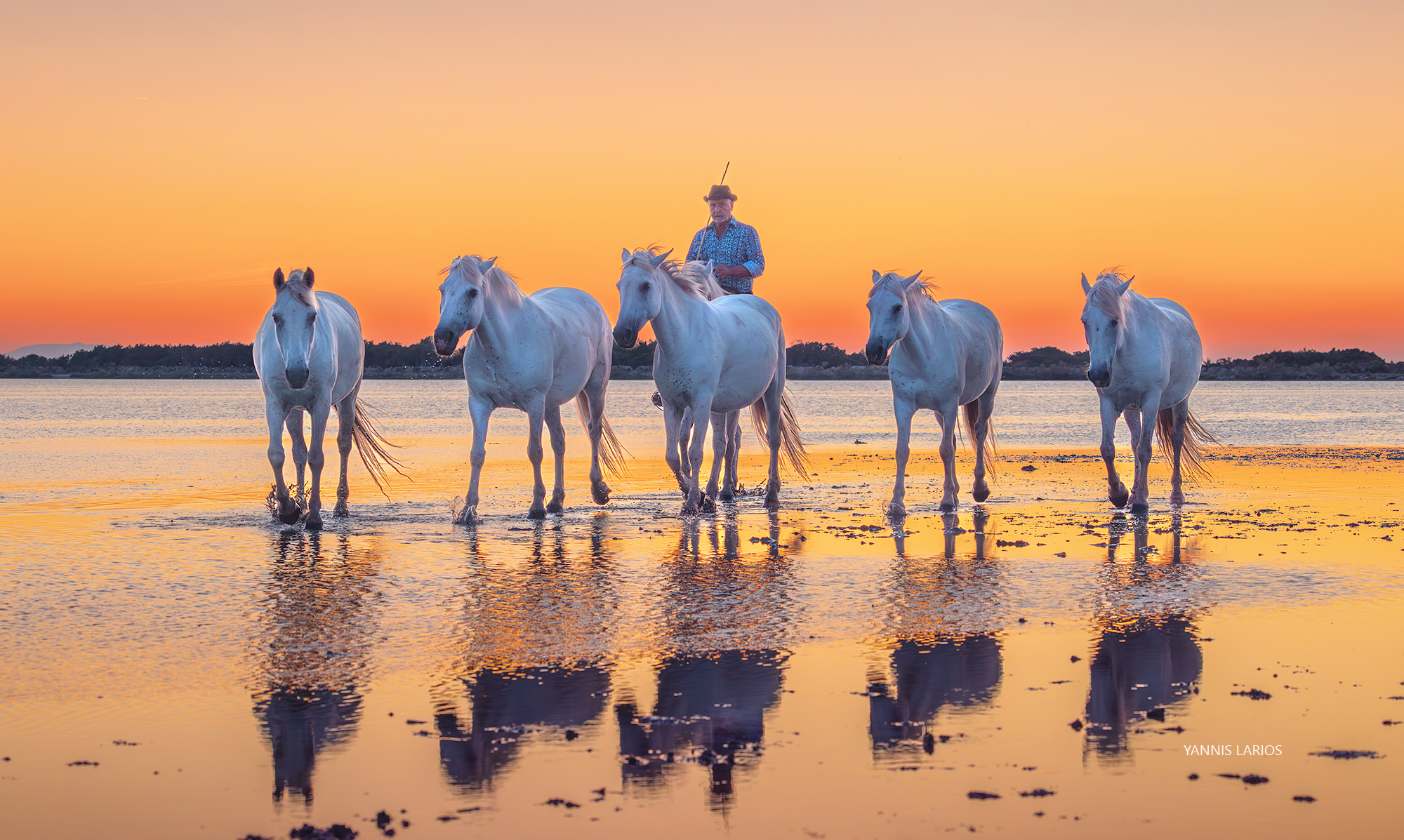
It's not about spectacular scenes or photos that "make an impression." It's about the time you dedicate. About observation. About silence. Sometimes in a wetland in Marseille, with the pure white horses passing by like otherworldly figures, other times lost in the fog of Meteora, and at other times in a magical landscape in Tuscany touched by the first light. In every new photographic mission, I feel like I carry all the previous moments with me—and that I am adding one more. A new experience that teaches me something deeper.
Nature never shows you all its secrets at once. It requires repetition. Presence. Humility. And through this journey, photography is transformed into something much more than an image. It becomes a way to understand the world. And that is what keeps me active. That is what continues to change me.
7) This year, we have the pleasure and honor of hosting you as a guest at the "1st International Kalamata Photography Meeting," organized by the Kalamata Photography Group. We would like you to share a few words about your participation and, if you wish, send a wish or a message to those who will be participating and who love photography.
This year's "1st International Kalamata Photography Meeting" is not just another photography festival. It is a multifaceted, substantive gathering of people from many corners of the world, who approach photography with depth, consistency, and creativity. Exhibitions, talks, experiential workshops, interactive visual experiences, and open discussions—all point to a serious and well-thought-out effort to give photography the space it deserves: as an art form, as a field of exploration, but also as a social interlocutor.
And it is very significant that all this is happening in Kalamata. In a city with a deep cultural footprint and a sense of historical continuity. It is a great honor for me to be among people who are building such bridges—between different perspectives, generations, and artistic temperaments.
In this context, I personally plan to open a discussion about landscape photography, not only as an aesthetic rendering of nature but as a way to recognize our place within it. I am thinking that it might be interesting to speak not in technical terms, but about the "materials" and the approach that give birth to an experience deeper than the simple recording of an image.
I hope this first international meeting will mark the beginning of a lasting institutional presence on the European map of photography. Just as the city of Arles in France became the unofficial capital of European photography, Kalamata has the potential, the passion, and the background to evolve into a similar, open space for exchange and inspiration. And the mere fact that this beginning is being made is a great thing for photography. Let's all support it because something like this is possible to achieve!
Two
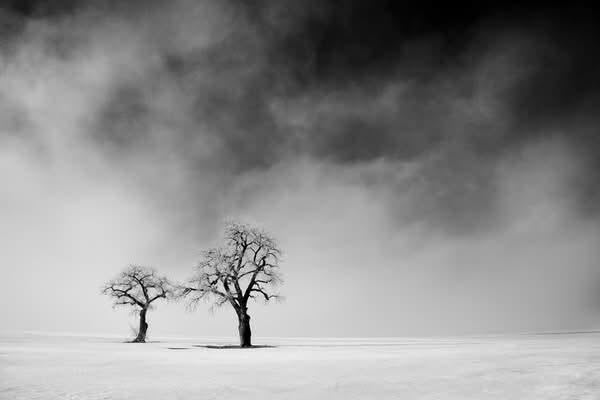
Our monthly theme for friends of our Facebook group.
Grab your camera or phone, explore this month's theme and share your own shot with the group.
Newsletter
Contact
-
Address:
Building No. 9, Eastern Center, Kalamata
(opposite ERT Kalamata) -
Phone:
+30 6974 655 551 -
Email:
photokalamatas@gmail.com - Website: www.fokal.gr
Social Media
-
Facebook Page:
Kalamata Photography Association – F.O.KAL. -
Facebook Group:
Friends of the Kalamata Photography Association – F.O.KAL. -
Instagram:
@fokal_kalamatas